
The $12,000 Permit: Navigating the Most Expensive ADU Market in Massachusetts
In the shifting landscape of 2026 Massachusetts real estate, the Accessory Dwelling Unit (ADU) has become the gold standard for property optimization. However, while the "by-right" legislation has opened backyards across the state, the cost to cross the finish line varies wildly by zip code. If you are looking to pull a permit in 02138 (Cambridge), you are entering the most expensive ADU approval environment in the Commonwealth.
Subterranean Solutions: When You Can (and Cannot) Build a Basement ADU
In the wake of the 2024 Affordable Homes Act, the basement has become the most contested territory in Massachusetts real estate. As we move through 2026, homeowners are racing to convert underutilized storage space into "internal" Accessory Dwelling Units (ADUs). While the state’s new "by-right" law makes these projects legally possible, the physics of a basement often dictate whether a project is a "go" or a "hard no."
From Concept to Keys: The 2026 Timeline for a Detached ADU in Massachusetts
As of May 2026, the "by-right" era of Massachusetts housing is in full swing. With the recent release of the state’s pre-approved ADU designs and the stabilization of dedicated loan products, the path to building a detached backyard home is clearer than ever. However, while the red tape has been trimmed, the physical reality of New England construction remains. For a homeowner in 2026, the journey from an initial consultation to a final move-in typically spans 9 to 12 months.
Financing the Dream: Finding the Right ADU Lender in Massachusetts
As the 2026 construction season kicks into high gear, the "missing link" for many Massachusetts homeowners has finally arrived: accessible, specialized financing. While the 2024 Affordable Homes Act made building an Accessory Dwelling Unit (ADU) legal by-right, it was the subsequent launch of dedicated loan products in early 2026 that truly moved these projects from blueprints to backyards. Navigating the lending landscape requires understanding the new state-sponsored programs versus traditional private equity options.
Capital Gains and Backyard Densification: The ADU as a 1031 Exchange Strategy
As the Massachusetts real estate market enters the mid-point of 2026, institutional and sophisticated individual investors are pivoting toward a new method of portfolio optimization. While much of the early ADU conversation focused on housing family members, the true "alpha" in the current market is found in the strategic use of Accessory Dwelling Units to facilitate 1031 Exchanges and aggressive Cap Rate compression. By transforming a standard single-family rental into a multi-unit income stream, investors are finding a path to tax-deferred growth that traditional assets no longer provide.
Build vs. Buy: The 2026 Financial Arbitrage of the Backyard ADU
In the current Massachusetts real estate climate, the "starter home" has become something of an urban legend. As of May 2026, median prices for a modest 1-2 bedroom home in counties like Worcester or the North Shore often start at $450,000 and climb rapidly toward $800,000 in MetroWest. For many families and investors, this reality has sparked a critical debate: do you compete in a low-inventory market to buy a smaller second property, or do you build a new Accessory Dwelling Unit (ADU) on land you already own?
Blueprint for the Future: Governor Healey Announces Winners of the Massachusetts ADU Design Challenge
In a significant move to accelerate the state’s housing production, Governor Maura Healey and the Healey-Driscoll Administration announced the winners of the inaugural Massachusetts ADU Design Challenge on May 1, 2026. This announcement marks a critical milestone in the Commonwealth’s effort to make Accessory Dwelling Units (ADUs) a cornerstone of affordable, sustainable living. By awarding eight winning designs from a pool of over 100 submissions, the state is providing homeowners with a library of "pre-approved" prototypes that promise to slash pre-development costs and simplify the journey from concept to construction.

Converting Fieldstone Foundations into Legal ADUs
In Massachusetts’ Gateway Cities and historic hubs like Worcester, the most common hurdle for the Plus One strategy isn't zoning—it’s geology. Thousands of properties built before 1920 sit on fieldstone foundations: massive, irregular granite blocks held together by century-old lime mortar.
Converting these basements into Accessory Dwelling Units (ADUs) is the ultimate value-add play, but it requires moving beyond standard carpentry into the realm of structural masonry and advanced moisture management.
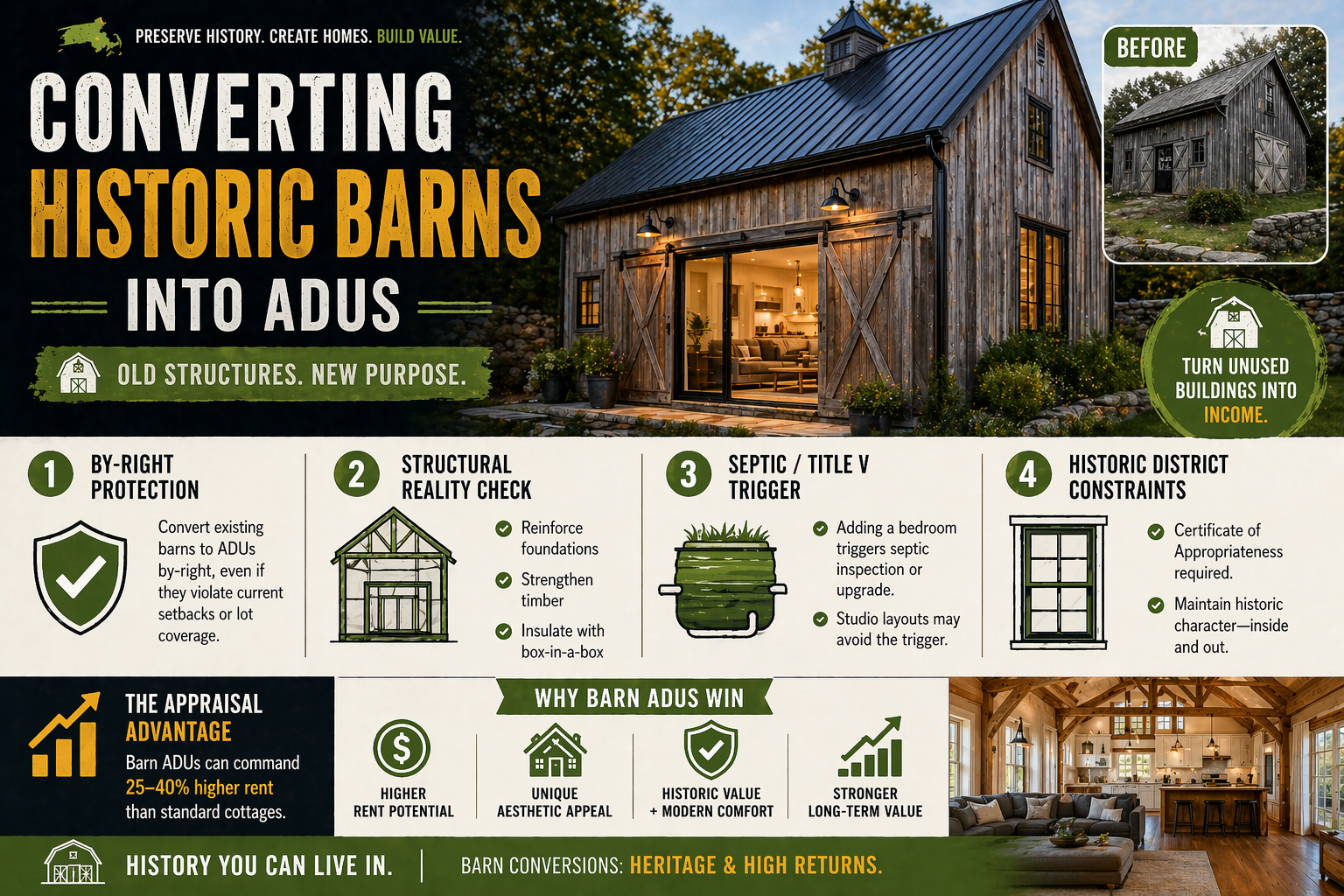
Converting Historic Massachusetts Barns into ADUs
In the Massachusetts real estate market of 2026, the barn conversion has moved from a luxury hobby to a strategic housing solution. With the Affordable Homes Act now in full effect, many of the Commonwealth's historic outbuildings—formerly relegated to storage or rot—are being revitalized as legal Accessory Dwelling Units.
For a property owner or investor, converting a barn into an ADU is a high-reward play that balances historic preservation with modern density. However, unlike a basement finish or a garage conversion, barn projects carry unique structural and regulatory gotchas.

How to Vet and Select the Right ADU Contractor
Building an Accessory Dwelling Unit (ADU) is not a standard home renovation; it is a ground-up mini-construction project. In the 2026 Massachusetts market, where the Affordable Homes Act has triggered a gold rush of new builders, the challenge isn't finding a contractor—it’s finding the right one.
To feel comfortable with your choice, you need to move past gut feelings and use a vetting process designed for the unique complexities of ADU development.

How the 2026 Mini-Split Streamlining is Accelerating MA ADU Builds
For years, the mechanicals were the silent killer of the Massachusetts Accessory Dwelling Unit (ADU). You could have the perfect 800-square-foot floor plan, but as soon as you tried to tie a detached unit into an aging boiler in a Worcester triple-decker or run a new gas line across a lot in Milford, the budget—and the timeline—would spiral.
As of February 2026, the game has changed. The state’s new Unified Mini-Split Guidance has effectively turned the HVAC stall into a fast-track lane for savvy investors.

The "Plus One" Strategy: Unlocking Value in Massachusetts Multi-Family Assets
While the headlines regarding the 2024 Affordable Homes Act have focused on "granny flats" in suburban backyards, the most sophisticated investment play in 2026 is happening in the multi-family sector. The "Plus One" strategy—adding a single ADU to an existing two- or three-family property—is transforming how investors approach density and valuation in Massachusetts’ Gateway Cities.

The Permitting Fast-Pass: Exploring the 2026 Pre-Approved ADU Catalog Launch
For most Massachusetts homeowners, the dream of building an Accessory Dwelling Unit (ADU) has historically died at the drafting table. The soft costs—architectural fees, site surveys, and the agonizing back-and-forth with local building departments—can easily consume $15,000 to $20,000 before a single shovel hits the dirt.

Why Building an ADU in 2026 is Finally Within Reach
If you’ve spent any time in New England real estate, you’ve likely internalized a hard truth: nothing is easy to build. Between the discretionary town board meetings, the maze of historic district rules, and the high cost of construction, it’s natural to feel skeptical that the state's new Accessory Dwelling Unit (ADU) laws have actually changed the math.
But the data from the first half of 2026 tells a different story. If you’ve been holding off because you think it’s too hard, too expensive, or too legally complex, here is the reality of the New Normal.

Navigating the Short-Term Rental Loophole Closure in Massachusetts
The 2024 Affordable Homes Act was hailed as a watershed moment for Massachusetts housing, effectively legalizing Accessory Dwelling Units (ADUs) "by-right" across the Commonwealth. However, as the law’s implementation reaches its full stride in 2026, a significant point of friction has emerged: the tension between state-mandated flexibility and local short-term rental (STR) restrictions.

ADUs Are Becoming a Standard Home Upgrade
Housing costs remain high across Massachusetts. Families are looking for flexible living arrangements. And homeowners are increasingly interested in generating income from their properties.
Suburban Towns Are Finally Making ADUs Usable
Across suburban communities, towns are beginning to refine their bylaws to reduce ambiguity and improve usability.
This includes clarifying dimensional requirements, simplifying approval pathways, and aligning local rules with state guidance.
Parking Rules Are Quietly Limiting ADU Growth
In many Massachusetts communities, ADUs are technically allowed—but still difficult to build.
One of the biggest reasons is parking.
Local zoning often requires an additional off-street parking space for a new unit. On smaller lots, especially in dense areas, that requirement can be impossible to meet.
Pre-Approved ADU Designs Could Speed Up Projects
Custom architectural plans can cost tens of thousands of dollars and require multiple revisions to meet local zoning and building code requirements. For many homeowners, this is where projects stall before they even begin.
Central Massachusetts Could Be the Next ADU Growth Market
Larger lot sizes, more flexible zoning, and lower property costs create conditions that are often more favorable for ADU construction. In contrast, dense urban areas face physical constraints that limit what’s possible.